Children of Dune: Yet another sci-fi idol bites the dust
Goriwei
This is the second post in the Dune critique series. The first one on Dune: Messiah, is here.
::: {.captioned-image-container}


*** WARNING: SPOILERS ***
Some people just want to be evil.
Because Children of Dune, the third book in Frank Herbert's Dune series, is about such people, it deconstructs the genre of science-fiction and gives the lie to the genre's myriad conceits.
The book builds upon and rounds off the cynical world-view of the previous books, Dune and Dune: Messiah. Chiefly, it has it that religions are human constructs to fool the simple-minded.
True to its era (published in 1976), Children of Dune titillates with sexual incontinence. The strict feudal-type hierarchy of the society doesn't extend to matters of the bedroom. So the Baron Harkonnen uses various males for his sexual pleasure and then discards them sometimes killing them. The Bene Gesserit sisterhood orders its members have carnal knowledge of men whose DNA would support their breeding programme, whether or not they are married to said men, or to some other one. As for the main characters, Leto Atreides never marries Jessica, his concubine, but has two children with her. Paul Atreides, despite being married to Irulan, fornicates with Chani and has two children with her. Alia takes lovers, a couple of whom we know the names of, others we don't. The Fremen have "spice orgies" which presumably involves getting high and having sex with people you are not married to. At the end of Children of Dune, Leto II marries his twin sister (yeah, really), but insists that Farad'n Corrino have sex with her to produce offspring despite her being a child. I guess this makes Dune pro-pedo.
But Dune isn't only about sex, it's also about getting high. Dune gives succour to anyone who likes the idea that psychedelic drugs can give you greater insights into the universe. In fact the entire plot depends on the trips that characters have when they drop a tab… I mean..consume the spice melange.
The visions and consequent babbling of the elite junkies impress the masses making them worship said elite junkies as gods. It is not clear why these visions are so special, but the upshot is that drugs are not a problem in Dune, because they are part of the religion. So there is none of the moralising peskiness of your grandmother's (in 1976) religion or, indeed, supernatural sanction (more on that below). Dune presents a juvenile, f*ck-you-grandma type atheism, that would appeal to a teenage boy who, in 1976, just found his first Playboy magazine.
The religion of the world in Dune, created by the Bene Gesserit by a sort of scouting group or Einsatzgruppe called the 'missionaria protectiva', and then hijacked, centuries later, by Paul Atreides is inchoate and incoherent. It is unclear who or what is being worshipped. Is it Paul Atreides? His sister Alia? God (with a capital 'G')? Is it 'gods' (with a small 'g')? What do the priests do? Is there a liturgy?
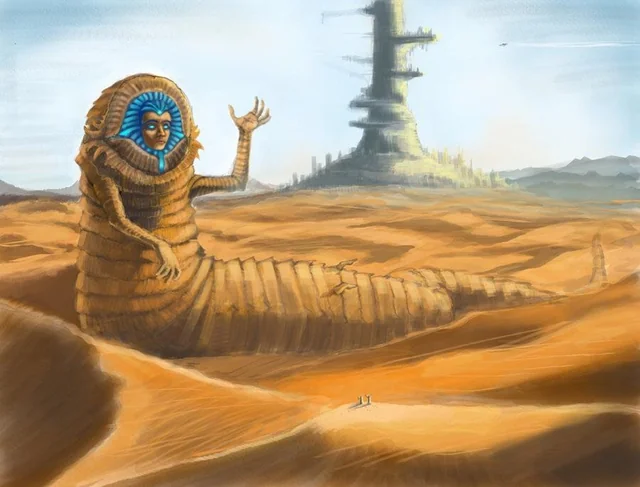
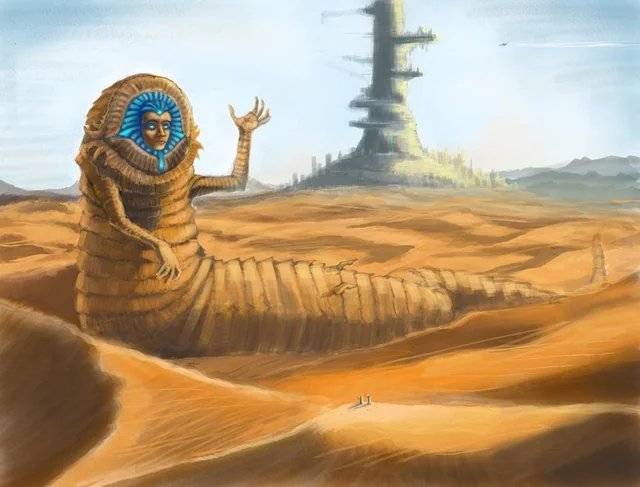
Herbert never cares to explain, probably, because religion is nonsense for stupid people so it doesn't matter that it doesn't make sense. Towards the end of Children of Dune, the focus of the religion shifts in that it is emphasised that the Fremen worship Shai-Hulud, a giant worm; it becomes a type of paganism. This shift is also a weak plot device (more below).
Despite pseudo-rationalist sneering at religion, Children of Dune is full of science-defying, fantastical make-believe. Because he has deeper insights into the universe, by taking loads of drugs, the child, Leto II has the special knowledge to meld himself with a creature from the life-cycle of the giant worms that inhabit Arrakis. This gives him super-powers like enabling him to jump from sand dune to sand dune cartoon-like as if he were superman or spiderman or something. The dénouement comes with a physical fight with his aunt, Alia, and because Leto has super-strength he wins it easily. So no tension there.
The episode of Leto gaining these super-powers feels like a deus ex machina contrivance inserted by Herbert because he needed to finish the book while getting the emperors to be thought of as gods and worshipped as such. This is, no doubt, why the religious focus changes to giant-worm paganism. It also offers a promise to the spergs of Silicon Valley how they too could be as gods: become trans-human by mixing their DNA with some alien space creature’s.
Through this power, Leto II, like a true evil lord, Pol Pot, say, is able to reset the known universe by unleashing a war, Kralizec, something like Ragnarok. Once everything is destroyed the Dark Lord can make back the universe to his liking, while insisting that it's all for your own good.
This is the central point of Children of Dune; it's about a class of junkies who can control great swathes of humanity, including getting them to go to their deaths in some crazy war for no discernible reason So, sort of like the leaders of the world in 2024. Yet, the book self-deconstructs, Herbert betrays his own conceits, and many tropes of sci-fi unravel.
These junkies, as long as they have the correct breeding, have access to memories of past lives. These memories are not merely static impressions, but have personalities and will. The memories can dialogue with those who are having the memories. In other words, these memories are indistinguishable from the entities that someone taking psychedelic drugs, say DMT, reportedly encounter.
The memories/entities can even take control of an individual. That is they can possess them. In other words, these "memories" are demonic manifestations. The word 'possession' is used in the book to mean exactly this.
So, Alia, who was exposed to a powerful version of the spice, "the water of life" while still in the womb of Jessica, becomes possessed by the spirit of the sadist and pederast, the Baron Harkonnen. By the end of the book, we find out that the child Leto II is possessed by an entity called Harum (This is a plot flaw, but we'll let that pass). It is under the influence of this Harum that Leto II will unleash a civilisation-ending war that will kill billions. Harum, purportedly the founder of a Mesopotamian or pharaonic dynasty, is nothing other than a demon.
At the start of the series, the psychedelic spice was cool because it enabled space travel. By the end, it is a way of opening doorways for demons. Rather than being secular/materialist, Children of Dune speaks of demons, the threat of coming under their influence and how psychotropic substances can open portals for them. This then is a spiritual sanction which deconstructs the underlying premise, "sub-text" if you will, of the modernist, rational, sci-fi Dune universe.
Herbert's characters did not have to come under the influence of demons. Herbert was born in and grew up in a Christian country. It is therefore inconceivable that he was not aware that there could be another path for his characters. His characters could repent and turn to God. The populations could also be encouraged to do so. This would lead them away from their destructive paths. This, though, is not a message that is ever articulated in Herbert's universe. One wonders why.
The result is that it is impossible to draw anything positive from the first three books of the Dune series. All the characters are on evil and destructive paths. It is very disturbing. It is demonic. Herbert gives us a universe that we must work to avoid. His sci-fi can only ever point us towards dystopia. No wonder J. R. R. Tolkien hated it.