Westminster Abbey and the Destruction of England
David Starkey is wrong. Dragging immigrants to monuments and tourist attractions won't make them Englishmen of them.
Goriwei
Can a bunch of old stones make Englishmen of immigrants? David Starkey, a TV historian, seems to think so.
Dr David Starkey, as a person from the television, is someone I never took much notice of, in the same way I didn't take much notice of other television people, say, Dale Winton, Graham Norton, Lyce Doucet, Carol Vordeman, Jeremy Paxman or Katie Price. Recently, however, Starkey got himself a YouTube channel, wherein he opines on the problems facing his country. His relevance has thus exploded. Not only that, but blogger and internet person, Millenium Woes, commented that Starkey wants to use history to inculcate an English identity into recent immigrants to the British isles. More specifically in an interview with, high profile youtubers, Triggernometry, Starkey suggests that to get migrants (and I guess the indigenous people) to connect with the true essence of Englishness, they need to be taken to national monuments so that they can have a transcendent experience which would so transform them in such a way that they would become English.
I can think of many monuments and august institutions that an immigrant
could be dragged to, such as any of the 874 (at the time of writing)
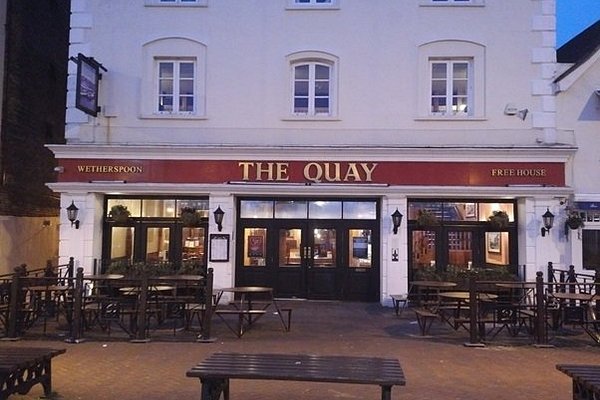
Wetherspoon's pubs. Or perhaps the giant dildo gherkin in the City
of London, or the Shard? What about Tyburn (or is it called "Marble
Arch" these days?)? Perhaps the Lloyd's of London building - an
essential node in the world of finance, but ugly and out of place, like
a cancerous growth seeping puss on the remnants of the shattered and
destroyed medieval city?
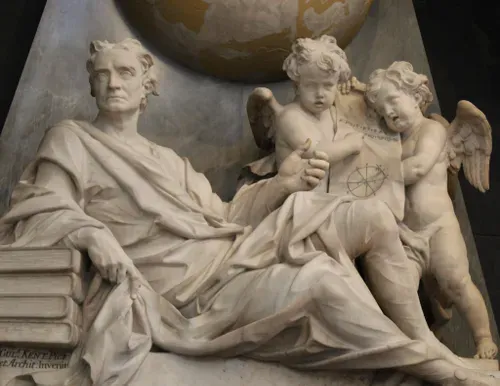
Surprisingly, Starkey doesn't suggest any of the above. What he suggests is that the poor, benighted immigrant be dragged to Westminster Abbey, presumably after having been relieved of the entrance fee of £30. Once in this building the migrants must be made to understand what it is that they are looking at so as to be inspired to the aforementioned transcendence. In particular, he suggests that the immigrant be placed in front of the statue of Sir Isaac Newton and the Handel monument to which, he says, the royal family bow. Is Starkey serious here? Has he actually thought this through? I really have doubts.
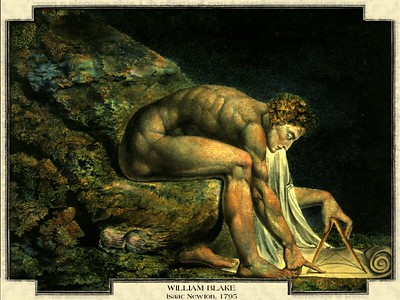
It certainly raises a number of questions. What sort of transcendental experience is one supposed to have when one's eyes rest on the figure of Sir Isaac Newton? Is the immigrant to be imbued with an instant understanding of the Principia Mathematica? Planetary motion? Apples? If not, what? I wish Starkey would explain.
What is clear from Starkey's language is that there is ontological essence of the English being towards which all those espousing to be English must orient themselves and travel towards. He uses clearly religious terms, which is surprising as Starkey is an avowed atheist and has explicitly rejected a return to religion.
The problem Starkey will face with his fetishising of monuments and statues of various odd bods, is that the plastic arts may whisper stories of which Starkey may not approve. Those dragged kicking and screaming to commune with the stones and the essences of Newton and Handel may come away with a different impression of Englishness than that which Starkey was hoping for.
For example, the poor, benighted immigrant might ask why Newton and Handel in particular? And why memorials to them are placed in an abbey? Are they not abbots? And if not, who are they? Your gods? He might also ask what a minster is. Is it something to do with the government?
The answer to these questions might make Starkey uncomfortable. The immigrant, who Starkey has dragged to the "abbey", might conclude that the glorious magnificence of the building sits uncomfortably with the sneering inversions (e.g. the Lloyds of London building) of modern London. The fact is that the stones of the Abbey whisper tales of different people with different values and different skill sets.
The immigrant might realise that the word "minster" is an Anglo-Saxon corruption of the word of the Latin monasterium and that a monastery was found on the site by the Anglo-Saxon king Sæberht of Essex (died 616 A.D), after a fisherman had seen a vision of St. Peter at that place by the Thames.
The immigrant may further understand that that sacral place was desecrated and art and treasures were removed with Henry Hose-Down's dissolution of the monasteries from 1536. In 1560, the murderous daughter of Hose-Down and his concubine, Anne Boleyn, made the Abbey a 'royal peculiar' and thus directly subject to the whims of the monarch.
Such desecration made it possible for the Abbey to be turned into a museum for the people who had the monarch's favour. Sir Isaac Newton was one such, notwithstanding that he was a heretic, an alchemist and an occultist. Georg Friedrich Händel was not even English, he came to England during the reign of George I, arguably a usurper, who wasn't even able to speak the language of the locals. The fact is that Westminster Abbey was not made by these people, nor for them.
The Abbey is the work of people for whom the exhumation of Edward the Confessor's incorrupt body in 1103 was a miracle. Edward was subsequently canonised in 1161. His shrine and his remains are in Westminster Abbey, but Starkey does not suggest that the immigrant contemplate that particular memorial. St. Edward died in 1066. Within months of his passing, England was invaded by a murderous lunatic who slaughtered the Anglo-Saxon ruling class and cruelly oppressed the population. Symbols of that oppression, Norman castles, littered the country. Many remain to this day, one such being the Tower of London (entrance fee: £34.80), which is another monument and tourist attraction that, perhaps, Starkey thinks an immigrant should be dragged to.
The fact is that the people who built Westminster Abbey are not the same people who later came to desecrate it with idols of heretics. The modern form of Westminster Abbey cannot be a summation of true Englishness, but rather the symbol of rebellion against the English. If the English are going to rebel against their ancestry and, therefore, against themselves, would not a migrant conclude that he can do so too? Isn't it, after all, the English 'thing'?
Rather than risking the consequences of an immigrant understanding this and learning the wrong sorts of lessons from Westminster Abbey, I'd suggest to Starkey that he take the immigrant somewhere else better to inculcate him with a less threatening type of Englishness, say that fine institution, a Wetherspoon's pub. At least it might be possible to get change out of £30.