Higher Education is Murder.
Ratter, the 2015 film, shows that modern life isolates people so as to better kill them.
Goriwei
The media industrial complex can't help but tell you what will become of you, if you follow the path laid out for you by the system they promote. This is what the film Ratter (2015) does. It functions as a revelation of the method, as it were, and must have been made in spite of itself.
It nods at a slew of feminist tropes of male predatory behaviour. The funding pitch probably went something like this: "this film turns the viewer's gaze onto the male gaze, taking the subject of oppression and objectifying the objectifier. The dominant power structure of the male gaze is thus deconstructed. The viewer, of no-matter-what gender, becomes the female-other and subjects the gaze itself to objectification. In this way it dissolves power structures and overthrows the patriarchy."
Unfortunately for the financiers, the film doesn't do any of that. Rather, it shines a critical spotlight on modern society, in which the financiers, and executive producers, are almost certainly well-paid cogs.
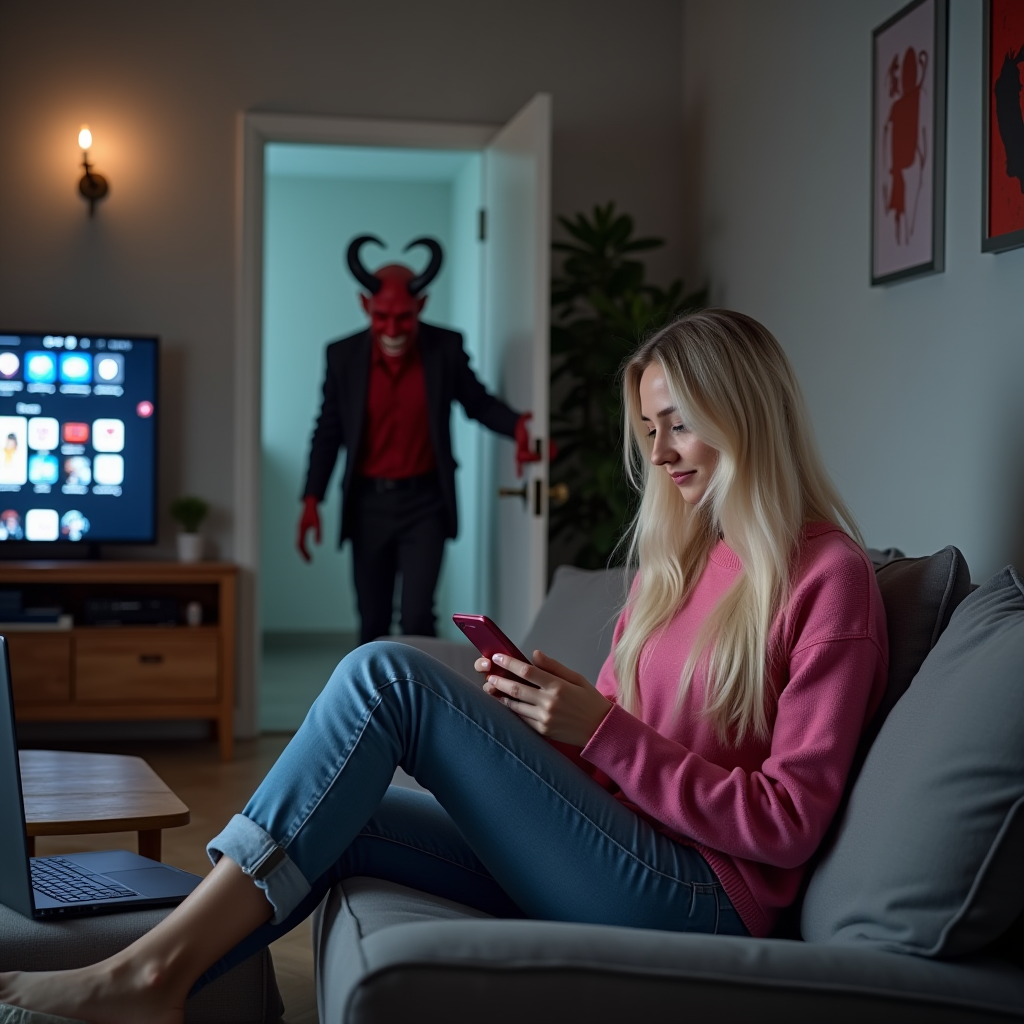
The camera frames almost every scene always from the point of view of the main character's (Emma's) devices. This makes the film about the gaze of technology, about surveillance capitalism, about the surveillance state. We become not the people who interact with Emma through the devices, nor the hacker who hacks into her devices, but the technology itself.
Emma has left her home town in Wisconsin to pursue postgraduate studies in New York. Because of this decision, she is almost always alone. She makes friends, but these friendships are shallow because they have to be formed on the basis on nothing except presence on the course. Ratter is a story of isolation through higher education.
She dates a classmate, 'Michael'. During their first conversation, when she says that she'd from Wisconsin, he responds with 'Good Cheese!'. She replies that that what everyone always says, underlining the point that they have nothing in common. The conversation then continues along the same superficial lines of people who don't know each other. We have a scene where Emma masturbates. Not long after, she ends up sleeping with Michael; there simply isn't anyone else. Big city life has left her desperate. She dates only so as not to be alone.
Emma's sense of loneliness never dissipates. She is only grounded by contact with her parents through video calls on her laptop. But as we see her interact through the devices, it becomes apparent that the contact with the people who really love her has become shallow and empty. The film shows that true closeness requires physical presence as well as emotional connection.

On the few occasions where the camera frames her alone in the flat, and alone at night in her bed, she is shown as ever more isolated, ever more lonely and ever more vulnerable. She is the perfect victim. But what has made her the victim?
Ratter casts a spotlight on the social condition of many in modern society. It forces us to ask questions. Why was Emma alone in New York? Was the course that she chose to study so much better than what she could study closer to home? Was the university so prestigious that it was worth the huge expense and risks involved? What did she really hope to gain from it?
The answers are uncomfortable for anyone who has bought into the current paradigm. By moving to New York she cut herself off from her support network, most importantly, her parents. She also broke a relationship to move. We don't know much about Alex, her ex-boyfriend, but he does come across as unstable. It's not clear whether he is the hacker who stalks her, but had she stayed at home, her wider support network could have dealt with him. She chose, however, to make herself vulnerable.
Ratter therefore is a film about a sick society that breaks normal social relationships and makes people vulnerable to predators. Ratter shows that the modern work creates a horror that is being alone.
Emma had gone to New York to study some sort of economics and become a lonely bug-woman technocrat to implement inhuman policies on people she will never know. Were she studying only for the knowledge she could have just read a book, but higher education offers credentials, public acclaim and entry into certain types of employment. Pride and avarice must be her motivations.
It shows that the "elite" university system is a trick to break up families and create corporate cookie-cutter drones who carry out the commands of the masters about the lives of strangers.
By removing herself from normal human contact and falling into shallow sex with someone she really doesn't have anything in common with, she becomes a rootless automaton. Losing her unique attributes makes her a victim.
Emma's fornication becomes the trigger for her stalker to take extreme measures. He is a monster from the id that crystallises her fears and her questionable decisions. The person who spies on her through her devices is a demon to take the characters to the destiny they have chosen themselves. The film echoes a Greek tragedy in which the protagonist is driven to her unenviable end by her innate essence.
Emma's decisions before the start of the film has her become an unperson in self-imposed ostracism from her community. As the ancient Greeks knew, ostracism is the same as death so the denouement of the film is the only logical end for a character who has been tricked by modern society.