The Terminator (1984) - A Tale of Sex and Death
How a One-Night Stand Doomed Humanity
Goriwei
You thought that the 1984 sci-fi horror flick, The Terminator, was about killer robots from the future. Think again. It’s actually about sex.
The Terminator might have been intended as low-budget B-movie schlock, but through some top-notch story-telling, it seized the imagination of the public and gave birth to a decades-long franchise. Many of its tropes continue to echo down the years.

The Terminator was released in 1984. The sexual revolution had been in full flight for more than a decade. Andy Warhol’s Blue Movie had been released in 1969, Deep Throat in 1970 which by the 1980s had main-streamed explicit sexual expression. A series of “sex comedies” had created the idea that men were subservient to their sexual lusts, which could make women vulnerable, or alternatively, powerful, depending on the context. Similarly, the AIDS scare was in full swing and people accepted that sex really did equal death.
In such a cultural milieu, it is not surprising that the male characters in The Terminator tend to be sex-obsessed rakes. When Sarah Connor, the heroine of the piece, and her flatmate, Ginger, are getting ready to meet their Friday-night dates, Matt, Ginger’s boyfriend, rings and starts to “talk dirty” on the phone, making uncontrolled male sexual urges and stalking themes of the movie. Sarah calls him ’the creep’ as she passes the phone to Ginger.
Sarah’s date cancels. Rather than luring a man, she is let down by one. On the answer phone he uses his full name, Stan Morsky, indicating that they don’t know each other that well. We also learn that the most interesting thing about him is that he drives a Porsche. Apart from flat-mate, Ginger, Sarah is alone in Los Angeles. She has no circle of friends. The rich guy she tried to pick up got a better offer on that particular Friday night. It’s not stated that she is an aspiring actress, but her life circumstances would be consistent with this and would have been something that James Cameron, the director of the film, would be familiar with.

Sarah having been stood up, announces she’s going to a movie. With Sarah gone, Ginger jumps straight into bed with “the creep”, Matt. While they are copulating, she listens to music on a Walkman. She seems to be enjoying the music more than being with him. Perhaps a plot device so that she doesn’t hear the villain of the piece, a Cyberdyne Systems Model 101 Series 800 Terminator from the future, break into the house, it acts to signify disassociation from the copulative act. When he finishes she goes to get food; she’s more interested in this than the sex. The sex is about him and not about her. In the framework of this movie, sex is something that men do to women.
In fact, Matt doesn’t seem even that taken with Ginger; when Sarah runs into him outside the front door of the house, he kisses her in a way that indicates he is as willing to sleep with Sarah as much as with Ginger. Sarah wanted a man with money, Ginger is happy with the sexual attention. In a short while, Matt will get his comeuppance.
The men, represented by Matt, are presented as weak and sex-obsessed; the women put up with it for companionship and money. Thus, the film taps into 1984 feminist critiques of the male gaze and objectification. The issue of female sexuality is never really addressed; Camille Paglia’s Sexual Personae, which describes female sexuality as dark, chthonic and Dionysian, was not published until 1990.
Sarah, out by herself, not having made it to the movie she was going to, is eating pizza alone in a restaurant, and, discovering a serial killer is after her, tries to make a phone call while a man leers at her. Once again, the film presents predatory, disordered male sexuality.

The man stalking her is Kyle Reese, sent back in time by John Connor, Sarah’s son, so he could sire John with Sarah. If you thought this was some weird, Oedipal, Freudian thing, you wouldn’t be wrong.
As Kyle follows Sarah, we see him as a sexual predator stalking a girl. Kyle’s creepiness is only confirmed when we learn that he fell in love with a photo of Sarah given to him by Sarah’s son. He is therefore literally stalking his sexual obsession, rather than ‘protecting’ her, in a way that is similar to a young man who is too scared to talk to his crush1.
Sarah, realising that she is being followed, attempts to find a functioning telephone and goes into a night club, Tech Noir. There, she telephones the police who tell her to stay in the club, a public place, where she will be safe. The music playing in the club is Burnin’ In The Third Degree by Tahnee Cain & The Tryanglz. It is a track about sexual desire and its release. So the place the police consider safe in 1984 is a place of heightened sexual passions, the very thing that might encourage a stalker.
The Cyberdyne Systems Terminator finds her there by listening to messages on the answer phone at the house where Ginger and Matt lie dead. Sex for them, really did mean death. To the terminator such things have no meaning. When it gets to Tech Noir, it is unmoved by the dancing, writhing bodies in the night club. It has no passions Like an uncontrollable force, it pushes through the crowd. It has a single purpose that it will pursue relentlessly. Its presence there serves to stop passions in others mostly by killing them. The terminator, full of logic gates and processors, single-minded in its mission, puts an end to the sexual, Dionysian passions in the night club. In an attempt to end Sarah’s fertility, it brings death to anything in its way.
By 1984, Studio 54 had been closed for four years. Disco was dead, but the idea of bars as places to find sex persisted. Saturday Night Fever had been released in 1977. Rod Stewart’s Da Ya Think I’m Sexy was a 1978 release. The Terminator was set in a world where meeting people in bars for casual sex had been memed into existence.
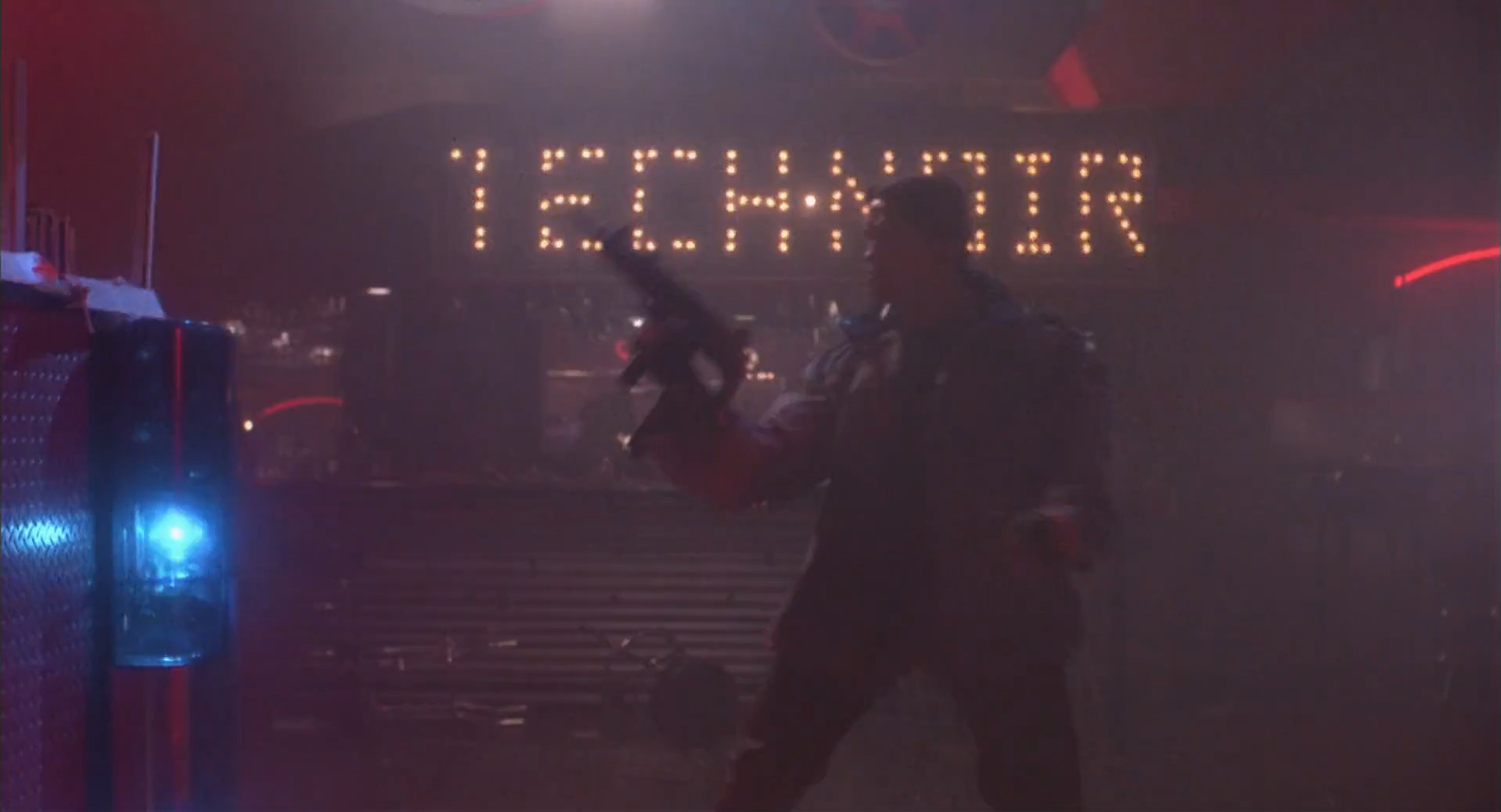
The other patrons of Tech Noir might have chosen to spend the evening there, but Sarah Connor ends up at the bar because she was stood up and stalked. The signification is obvious; she could be burning up both sexually and in anger, having had her date cancel on her, and in fear because she knows there is a serial killer out to get her. In her fraught emotional state, she does, in fact, meet a man in the bar. That man is Kyle Reese, whose first words to his crush are: “Come with me if you want to live.”
The terminator is a creature of industry and capital that has taken on a life of its own. It, automatic weapons in its hands, stands in judgement of the carelessness of the society in which it was created. The terminator is there to ruin your fun and your shot at casual sex. As Kyle says to Sarah:
It can’t be bargained with. It can’t be reasoned with. It doesn’t feel pity, or remorse, or fear. And it absolutely will not stop, ever, until you are dead.
Yet it is on an act of sexual intercourse that the entire plot and indeed the entire franchise depends. That is when Kyle and Sarah copulate and John is conceived. This is a climax in both senses. Many of the human characters are ‘burning’ with sexual passion. Matt and Ginger are killed soon after being engaged in coitus. The burning desires of the patrons of Tech Noir are doused in a hail of bullets. Sarah and Kyle, though, run away from the terminator and manage the act.
Sarah initiates intimacy with Kyle after he says:
John Connor gave me a picture of you once. I didn’t know why at the time. It was very old-torn, faded. You were young like you are now. You seemed just a little sad. I used to always wonder what you were thinking at that moment. I memorized every line, every curve… I came across time for you, Sarah. I love you. I always have.
And there it is. John Connor pimps out his mother to a fanatically loyal soldier, so that he, John Connor, can come into existence. Callously, he puts his mother in mortal danger and disposes of one of his most faithful fighters, so that he, John Connor, can rule the ashes of a dystopian future. In this film, we don’t get to meet John Connor and we can’t evaluate his character. Despite being in the future, he is something mythical, with a fixed will, and whose decision is known. Could he make a different decision? Within the logic of the movie that one future dystopia requires that he not. Sarah, who is in our narrative present, however, could.
It is not surprising that Sarah does not reciprocate Kyle’s rather weak declaration of love, but it explains his behaviour as a stalker; Kyle’s world is one where men, suffering in unrequited passion, are too scared to introduce themselves. It’s only because of imminent death that he speaks to her. He presents as a creep, so we should not be surprised that her first instinct was to run away from him.
Putting aside her son’s weird Oedipal complex manipulation, why would she sleep with him? Is it through pity? Is it revenge on Stan? Or is it duty, because at that moment she realises that her son has sent back Reese precisely so he can be conceived and she is, thus, relenting to her unborn son’s wish to be brought into existence?
She doesn’t talk about it, so we have few clues. We can surmise, that because she initiates and is in control of the intimacy, it’s not her first time. Although it is Reese’s.
This sex scene is the essential node in the lore of the franchise; someone from the future comes back to conceive the resistance leader of the future. If he had not done so, Skynet would not have sent the terminator to kill Sarah Connor. The entire loop could not have existed and the paradox would not have eventuated. Kyle Reese admits explicitly that he is from one possible future. This means that if Sarah had chosen differently, the film and the franchise would not exist. Her decision creates that narrative, but the narrative itself need not exist. Like a character in a Greek tragedy, she brings on tragedy by a decision. Yet, for true tragedy the character must consider the options and, fully aware of the outcome, takes the path leading to doom anyway. We don’t see Sarah weigh up the consequences of her decision. She just sleeps with Kyle. Does this mean she has the same moral fibre that that weak lustful men have? Her lack of discernment makes it tragic, but not tragedy.
Once John Connor is conceived, Sarah could have decided, that instead of becoming some sort of survivalist to train John, she could engage in political activism, and so warn of the excesses of the military industrial complex and automated weapons systems. Her failure to choose locks in the dystopian future.
So even if she slept with Kyle in a moment of indecisive weakness, the fate of the world is not predetermined. Her weakness arises from a sex-obsessed milieu and, not questioning the cultural climate, offering her body to Kyle, a man she met the night before, without weighing the possible consequences. Can The Terminator be read as such a morality tale? This article proposes that it can be.
The T-800 is a Frankenstein’s monster, a golem, that has escaped the control of its makers. Skynet was a defence network to protect the country so that people, like Sarah, Matt, Ginger and Stan could continue their frivolous lives, and their irresponsible behaviour.
When Kyle Reese materialises into 1984, it is into a trash filled back alley by a homeless drunk. He steals the clothes of the drunk and thus presents as a down-and-out. The T-800 materialises in more salubrious surroundings, at the Griffith Observatory, but trash swirls as it appears next to rubbish truck. Is the symbolism that the T-800 manifests from what society has discarded? or, that it has come to take out the trash?
The explicitly stated role of the terminator was to kill Sarah Connor and consequently prevent an act of copulation. In this it failed. It stated that the failure causes hope, because the failure allows a resistance against the annihilation of humans by the machines. It is, however, this article’s contention that that is too simplistic a reading, because the possibility of annihilation only arose from a society that allowed the immanentisation of the military industrial complex’s Skynet.
The film does not explore such human failings, but it does give us pointers. The social decay that both Kyle Reese and the terminator encounter when they first arrive in 1984, the institutional failure of the police and dysfunctional male sexuality all point to the absence of the obligations to one another and society.
This suggests that a different society, one which chose to responsibly shepherd its members, would not have given rise to Cyberdyne Systems, let alone Skynet. Yet, we cannot know if, had Sarah not slept with Kyle, the future dystopia created by Skynet could have been avoided. Up until the point she sleeps with Kyle, Sarah is portrayed as a victim of flaky, sex-obsessed, weak and, predatory men, having to be rescued by Kyle. In short, she is a victim in the same way that the homeless drunk man whom Kyle first comes across is a victim. After the cringe-worthy declaration of love, she initiates sex. One reading is that this is her point of empowerment where she gains agency. This article demurs. She sleeps with Kyle not so much out of desire, but out of weakness. It’s either because she pities Kyle, who has come back from the future solely to protect (and have sex with) her, or because pridefully she wants to become a mythic character as the mother of the leader of the future resistance.
It must be pointed out that Sarah’s sexual assertiveness is a male fantasy for those who wish to shirk the responsibility of sleeping with a woman, which may speak to the film’s target audience of teenage boys. Yet by the film’s own internal logic that sexual act is part of the cycle by which John Connor sends Kyle to his mother so that he would be conceived, and Skynet then sending the terminator to prevent the conception. If Sarah had it in her mind not to initiate, Kyle would not have existed, neither would the terminator, and she could have worried about finding a date other than Stan, rather than fearing a future dystopia.
The portrayal of the characters as sexual rakes, can not be seen as separate from the social decay that the film and the dominance of the military industrial complex, through Cyberdyne Systems. Skynet did not emerge from nothing, but from the same people, with the same weaknesses. A society with more social solidarity, less atomisation, would have given rise to a different outcome.
In 1984 Arnold Schwarzenegger was not yet a super star, and playing this villain catapulted his film career. Unlike the other male characters who provide either comic relief (the police) or are sex-obsessed rakes, the Schwarzenegger’s terminator presents another view of masculinity. It is menacing, determined, aggressive and relentless. This is further explored in the sequel film, Terminator: 2.
When James Cameron and Gale Anne Hurd conceived of a low budget sci-fi horror, it is unlikely that they ever assumed that it would grab the public’s imagination, and give birth to a decades-long franchise. That is not to say the film doesn’t have its faults. Sometimes the performances are wooden maybe because much of the writing is contrived and clunky. There is no verisimilitude in the police procedure, so the policemen, acting as comic relief, only serve to show institutional failure. Nonetheless, the film tapped into the cultural atmosphere, which caused its tropes to persist until today.
The film brought together certain themes, including, social decay, lack of public services, broken families and a dysfunctional dating life. None of this is necessarily inevitable. It’s Sarah’s decisions that get her stuck in a time-travel paradox. It would have taken any one character making a different decision to stop it. Yet, they didn’t.
So, think before you hang out in sketchy bars; you might be able to avoid dystopia.
-
This makes Kyle, Voxday’s creepy gamma male. ↩︎