Terminator 2: Why Only the Robot Can Be a Good Father
T2 and the Communities We Lost
Goriwei
“It’s in your nature to destroy yourselves,” says the T-800, a robot from the future, to John Connor, the boy whom he has been sent to protect. This renders null the very mission of the T-800; to protect that boy so he will lead the resistance and ensure the survival of humans.
The essence of this ’nature’ is not stated, but the accompanying scene, which shows two young children squabbling, suggests that this nature is to violence. The rest of the film, though, witnesses otherwise.
While, ostensibly the two first Terminator movies are about killer robots sent back from the future, the main themes are social and moral failings. Perhaps the ’nature’ of humans is not to violence, but to moral weakness. So, if one possible reading of the 1984 The Terminator is that it is a movie about a one-night stand, Terminator 2 is about the consequences of that one night stand, of a single mother trying to bring up a child in a world she chooses to stand against.
The action scenes notwithstanding, the dialogue, characters and themes are an unsettling social commentary. It is a movie about people formed by post-WW II mores, to wit, the rise of suburbia, social atomisation, the break up of communities, secularisation, increased divorce rates, increased rates of children born out of wedlock and, of course, the sexual revolution. It is a film about people broken by the very system that produced the film.
Sarah Connor, heroine of the film, and mother of the future resistance leader, John, is very physically fit. When we first see her she is doing pull-ups. Soon after we see her engage in acts of violence. She is trained for direct physical violence, and embraces that role. We later find out that she has had a series of short-lived relationships; by her own admission, she is easy with her affections. While the T-800 robot, sent back from the future to protect John, and talks to him, she ruminates thus:
Watching John with the machine it was suddenly so clear, The terminator would never stop, it would never leave him and it would never hurt it him, never shout at him or get drunk and hit him, or say it was too busy to spend time with him. It would always be there. And it would die to protect him. Of all the would-be fathers who came and went, over the years, this thing, this machine, was the only one who measured up. In an insane world, it was the sanest choice.1
She’s been with men who leave, hurt John, shout, have alcohol abuse and anger issues, and were occupied with their own projects. It also shows that she has a penchant for the wrong type of man. Perhaps, the short-lived and highly fraught relationship with Kyle Reese in T1 became a model for relationships that she tried to repeat. Her outer toughness is a foil for an internal fragility.
John gives us some insight into his mother’s relationships:
Most of the guys Mum hung around were geeks. There was this one guy who was kinda cool. He taught me about engines… Mum screwed it up of course. She’d always tell them about judgement day and me being this world leader. And that’ll be all she wrote" 2
Although he judges both these men and his mother, John doesn’t explain why they were geeks; for John, a “geek” is contemptible and certainly not a role model. Perhaps Sarah tried to use the geeks to understand computers and the geeks he refers to are like Myles Dyson, the computer scientist, who is working on a new chip that would eventually lead to Skynet and the attempted destruction of humanity. Sarah’s insistence that John become a military leader, might have encouraged such disdain for “geeks”.
Earlier, John said this to the T-800:
We spent a lot of time in Nicaragua and places like that. For a while she was with this crazy ex-Green Beret guy, running guns. Then there were some other guys. She’d shack up with anybody she could learn from, so she could teach me how to be this great military leader. Then she gets busted and it’s like: ‘Sorry kid, your mom’s a psycho. Didn’t you know?’ 3
He pronounces “Nicaragua” with a Spanish accent indicating he can speak Spanish. From 1985, former U.S. special forces including Green Berets and other mercenaries had been set up to support the US’s guerrilla war against the Sandinista government (a year after the first Terminator movie) to 1990 when peace was established. The US armed the ‘Contra’ rebels. Because this was illegal under US law, the CIA funded it by drug-running and selling weapons to Iran, funnelling proceeds to the Contras. This resulted in the “Iran-Contra” hearings and the indictment of Colonel Oliver North among others. These activities also spanned Costa Rica and Honduras. After 1990 the mercenary activity wound down, by the time the film is set in 1995, this activity would have stopped.
So the picture we are getting of Sarah is that after the trauma she experienced in the first film, she fell in with people who were engaged in black ops in central America and acted beyond the law. When those wars ran down, she was not able to integrate back into society.
John says of her:
…she’s a complete psycho. That’s why she’s at Pescadero. It’s a mental institute. OK? She tried to blow up a computer factory. She got shot and arrested.[..].She’s a total loser. 4
We thus see Sarah’s relationship progress from Kyle Reese to special forces to “geeks”, from whom she presumably wanted to learn about computers, and finally into insanity. She sought out men who would support her world view. She ended up with instability and lacked the mental tools to deal with it.
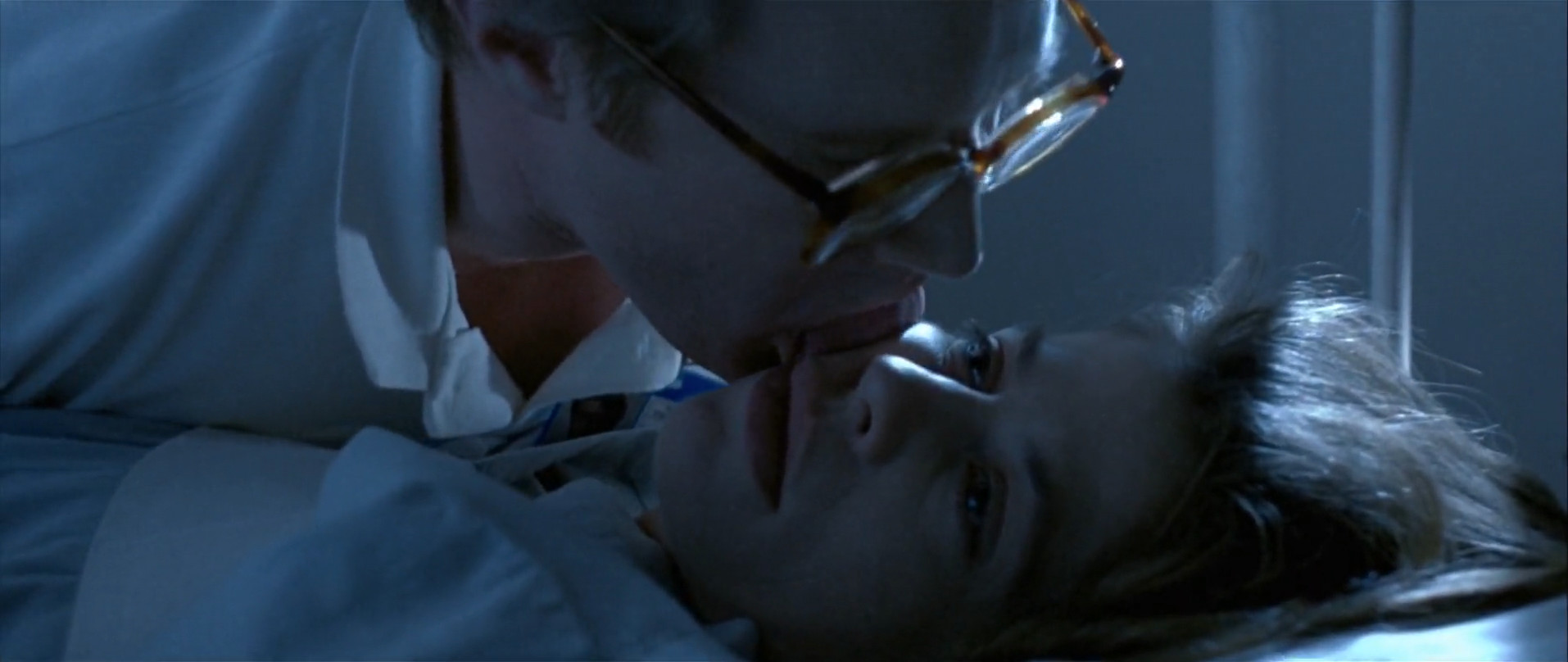
Her mental state led her to attempt to blow up a computer factory. Even with her knowledge of the future, and even if we, the audience, accept what she says, her incarceration in Pescadero is well-founded.
Sarah’s incarceration emphasises her solitude in a hostile world. In the first film she had only one friend, Ginger. The only other people with whom she had normal relations were her Friday-night date, who stood her up, and her mother, who was far away, “in a cabin”. She had no support structure, no wider family, nor community to which she could connect. The only person she had intimacy with was Kyle Reese and he was quickly dispatched by a terminator. Otherwise, she only has contact with failing institutions: police and psychiatrists. This long-term lack of community is perhaps the cause of her inability to relate to others, including the men she takes as lovers. It is the cause of her failure to navigate institutions and the inability to keep her emotions under control when required. In short, she lacks a broad human formation; it is no wonder she grabbed onto people on the fringes of society and beyond the law. Isn’t it also true that those from unstable homes end up in fringe groups and abusive relationships and often with addictions?
This lack of a well-rounded education and a community to guide her would also be a reason for her ineffective campaigning and her failure as a mother. For example, she could have campaigned to warn of the excesses of the military industrial complex without having to talk about killer robots from the future.
Better formation may have helped her conceive of a method to dispatch terminators. From the first film we know that fire arms are not effective against them; the sorts of weapons which are designed to kill humans are not what you’d choose to fight a terminator. Rather, an electromagnetic pulse weapon could disable a terminator or destroy it. In 2025 we know from the Ukraine war that microwave energy weapons are effective against drones. In 1991, when the film was released, this was theoretically known. From T2 we know that cold and heat are both effective against the T-1000 models. We also know that computers are vulnerable to other forms of attack including “hacking”.
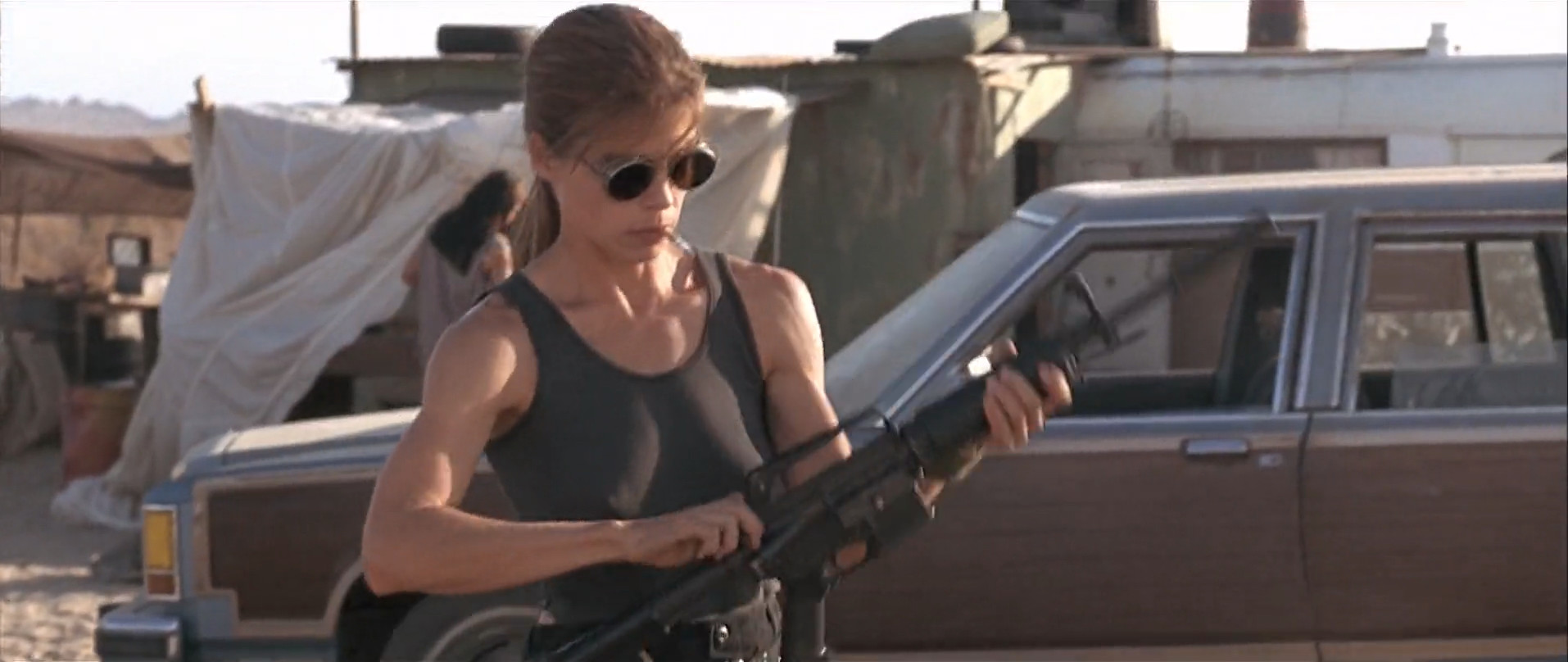
So rather than gun running, developing a knowledge of electronics, engineering and computer science would have been far more effective. Political activism could be effective in bringing an awareness of the dangers of automated computer systems that are given decision making powers. Her apparent obsession with firearms is misplaced and speaks to the nature to self-destruction referred to by the T-800; she is preparing for the wrong fight. The nature, therefore, is to a lack of discernment due to a lack of formation and is not innate in humans; it is something that can be corrected.
The film itself makes this point. Having seemingly done no research on the possible origins of Skynet, she asks the T-800 what events transpired that led to dystopia. It tells her that a particular engineer, Miles Dyson, is responsible. Sarah, true to her fragile mental state, attempts to assassinate Dyson with a sniper’s rifle. John and the T-800 stop her and then, through dialogue, persuade Dyson to destroy research into the chip in an attempt prevent the rise of Skynet. This is successful and has the effect of pushing off “judgment day” from 1997.
Although, T2 may very much be about the failure of Sarah Connor as a mother, it also deals with failure of fathers.
We see Miles Dyson so obsessed with silicon-chip design, that he doesn’t want to spend time with his children. He is similar to the ‘geeks’ who had no time for John, with the difference that Dyson is the biological father of his children and after persuasion by his wife, does decide to take the children out.
At the start of the film we are introduced to Todd Voight, John’s foster father, with whom he is placed, because of Sarah’s incarceration. He is presented as a stereotypical, lazy, sports-watching beer drinker who prefers to spend his time watching TV. Although, it seems they paid for a motorcycle for John to work on and a rather impressive toolbox. The implication is that they feel that pandering to John’s interests, is enough to make up a lack of parenting.
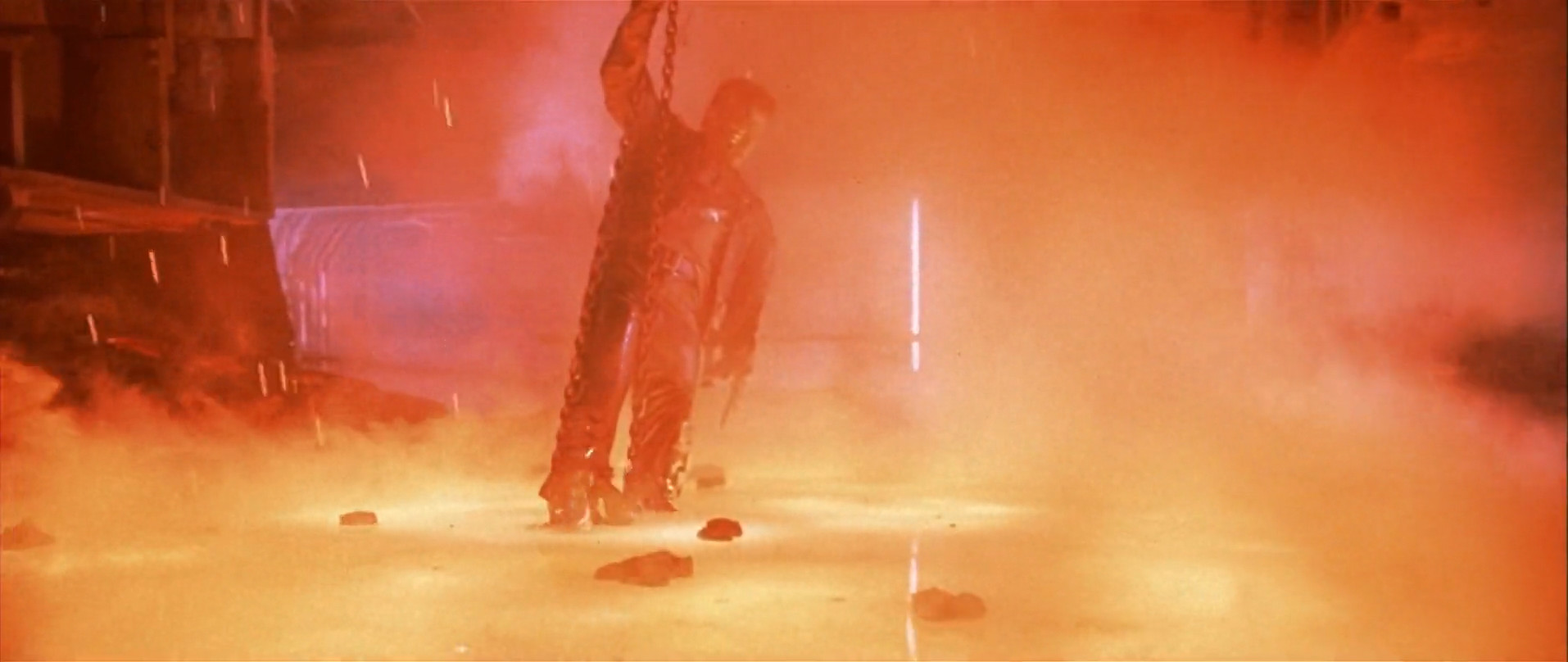
The only father figure who measures up is the T-800, who decides to sacrifice itself so that its parts will not be used as a springboard for creating Skynet and the future dystopia. The T-800 destroys itself to save John. It dies so John may live.

In T1 we saw social decay, fornication and institutional incompetence. In T2 we see all these things and their consequences. As in T1, institutional failure is a theme of T2. John’s foster parents are so incompetent that one wonders what institution thought they were suitable. In Pescadero, Sarah is abused and sexually assaulted, showing a failure of the health system. Her doctor, Dr. Silberman, is condescending and dismissive of what he believes is a serious medical condition. The police are incompetent.
So, rather than a sci-fi action-thriller, we have a film of social and moral failure that leads to institutional incompetence and the inability of Sarah Connor to campaign effectively against the excesses of the military industrial complex.
T2 is about the mental breakdown of people who behave according to the lax behavioural codes established by the sexual revolution. Consequently, they lack the skills necessary to navigate the world and be effective in it. The social failures woven through T2 are the same social failures of our society. Only that in our society the dystopian technocratic future seems so much closer.
Thus the ’nature’ of humans to self destruction as referred to by the T-800, is their lack of a moral compass, a lack of character, resulting in a lack of ability to discern, which causes a breakdown in the supporting social structures. T2 not only offers this critique of humans, but it also points to a solution. Myles Dyson, may be presented as a flawed human, but he has a stable relationship, and despite his obsession with work, is still presented as a loving father. He becomes the key to heading off “judgment day” and is willing to sacrifice himself for others. He puts the good of others, including his children, above his professional pride. So even with an underdeveloped sense of morality, he is able to listen, learn and take rational, if inadequate, action. His example, points to what it would take for people to develop the moral fibre to take the decisive action that would enable the institutions to work properly.
T2 is a film about social breakdown caused by people accepting the morality of post-WW2 west. It also offers hints at how such a society might be repaired. So the T-800’s diagnosis is incomplete: it is not in our nature to destroy ourselves, rather mal-formed people make mistakes.