Spielberg's Aliens Are Demons
They abduct children, possess bodies, and play technical tricks. Disclosure Day meant to elevate aliens above God. But the film reveals a far older deception.
Goriwei
Steven Spielberg has tried to make aliens cool again. It hasn’t worked.
Perhaps in Disclosure Day he intended to use extraterrestrials as a meditation on faith in a secular age. Perhaps he meant to challenge Christianity with demonstrations of science. But what’s he’s actually given us is a film about child abduction, bodily possession and psychological manipulation.
Disclosure Day is the latest in the many media properties about visitors from beyond the stars. Spielberg has form in this genre with Close Encounters of the Third Kind and E.T. the Extra-Terrestrial. The government’s secret alien programme was a running theme in the X-Files of the 1990s. The U.S. government has also weighed in on the alien narrative with the recent release of material on “Unidentified Aerial Phenomena” allowing the media to speculate that these must be visitors from the stars. Disclosure Day steps right into this media mêlée.
The “disclosure” in question is, of course, that aliens are real, their spacecraft have visited Earth and that they have come to offer us special knowledge. Instead of something truly revelatory, the message turns out to be that “empathy” is the highest value. So far, so underwhelming. After all the effort of crossing interstellar space, it seems like a bit of a waste if the knowledge is something that could have been gleaned from an HR seminar, a Guardian leader, or, indeed, a slightly dim teenager’s TikTok. However, to deliver this banality, Spielberg offers us a twisted and convoluted story involving child abduction, mind alteration, and bodily possession.
Alien Abduction
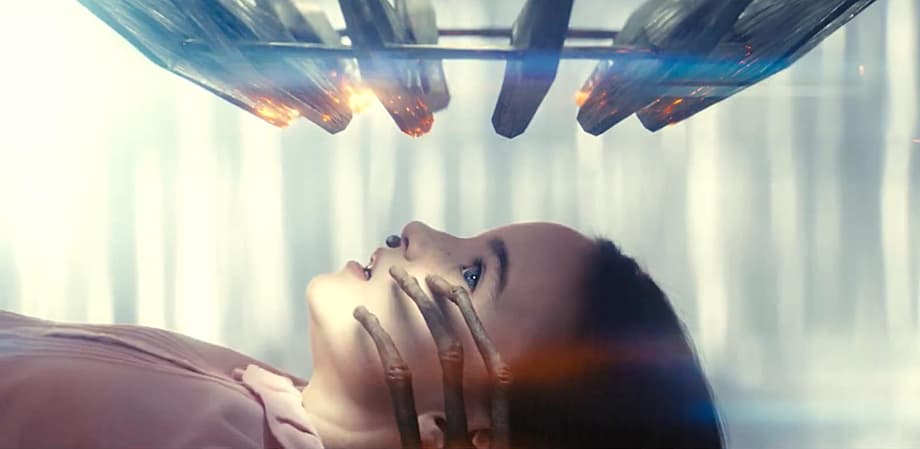
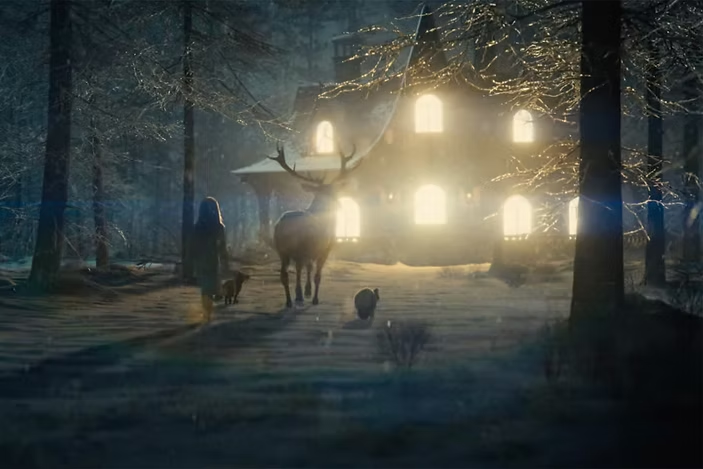
In flashback, about 30 years prior to the main events in the film, we are shown how the aliens abducted two children, Margaret Fairchild and Daniel Kellner. During the abduction the children are taken to a cottage that, we are told, is similar to the Hansel and Gretel fairy tale, which is to ensure that children are not frightened. Perhaps Spielberg forgot his fairy tales, perhaps he is hinting at a sinister subtext, but the cottage in the fairy tale is the home of a witch where the children were to be fattened to be eaten. Hansel and Gretel were also abandoned by their parents. Rather than being reassuring, the cottage signifies something far, far darker.
While in this alien facility, or cottage, the children are subject to a procedure whereby their brains are modified in such a way that they can be activated later. Daniel Kellner, played by Josh O’Connor. is activated before the main action of the movie starts. Margaret Fairchild, played by Emily Blunt, works as a TV weather presenter. She is activated, like a sleeper agent, by seeing a cardinal, the bird, not a prince of the Church. Soon after this we find she speaks fluent Russian, Korean and a clicking language that only Daniel can understand. So far, so amusing. But the dark truth is that neither child consented, nor did the parents, to a procedure where their adult consciousness was irrevocably changed. Not only was this consent denied to them as minors, but it is too late for them to consent retrospectively as adults. Margaret has become a vessel of the aliens, her very humanity thus denied. Whatever the aliens may claim about empathy, they have none for Margaret and Daniel.
Come to be fattened up.
Alien technology also allows a process called “diving”, by which one person, the “diver”, can take control of another person’s body. In short, it’s a type of possession. Using such a device, Noah Scanlon, played by Colin Firth, is able to possess Jane Blankenship, played by Eve Hewson, who tries to resist the possession by grasping her crucifix so hard that it makes her hand bleed. Ultimately, her resistance fails and she drops the crucifix. The suggestion is that religion and, in particular, Catholicism, is powerless against superior alien technology. The film though undermines the point it wants to make.
Jane is not a woman of strong faith let alone “Catholic” in any but the most superficial sense. She is a former novitiate who left the convent, drifting into an affair with Daniel. When she and Daniel take refuge in her erstwhile convent and she talks to him about her Christian faith, he challenges her with, “You left the church”. She replies, “Because I could no longer say with certainty that God is divine. … God is essential because it’s how we define ourselves and this belief keeps whole civilisations together. … We’ve been raised to believe in a supreme being. And now you want to show us actual supreme beings…”. So Jane came to believe that God is not a reality, but a constructed narrative that is useful for maintaining the social order and giving meaning to human life. If another more persuasive narrative is presented, there is no reason why it might not replace “God”. This may well be Spielberg’s personal view.
Thus, by the time she grabs the crucifix to resist the possession, it is far too late; if God is only a useful civilisational myth, Scanlon is simply presenting a another narrative, a stronger myth and better technology. Later, when he again possesses her in an attempt to use her to kill Daniel with a knife, Spielberg allows the camera to linger on her injured hand, inviting the viewer to see something like the stigmata, a replica of Christ’s wounds which appeared on a few of the most devout saints. Because of what we already know about Jane, the comparison falls flat. Jane is no saint. Her “faith” is only the shards of a narrative.
The scene thus founders and the film fails to address the core point. What if the God of the creed, that Jane, as a novitiate, would have recited by heart every day, is real? What if, in clutching the crucifix until she bled, she had identified with Christ’s passion? The film can’t go there, because to do so would be to deny the notion that religion is, at best, a useful fiction. We never see what would have happened if the alien technology was matched against the genuine supernatural faith that Jane, as a novitiate, would have been immersed in.
Disclosure Day toys with the idea that proof of alien life might shake Christianity to its foundations. This conceit is now so familiar as to be trite. If the cosmos is populated, the argument goes, and if more advanced beings exist, people cannot claim to be uniquely saved by God, religion then just collapses under its own contradictions. But on the film’s own terms, this just doesn’t pass muster. The aliens are neither omnipotent nor moral. Their craft crash. We see video footage of dead aliens and of their capture by US military. They engage in child abduction, medical procedures without consent, and they use people’s bodies as instruments, while teasing mankind with promises of secret wisdom.
Peoples all over the world have names for entities that induce visions, manipulate perception and override the will all while offering salvation through special knowledge. Spielberg’s disclosure that the aliens are “greys” of modern UFO folklore is not without significance; they are associated with abduction, sleep paralysis and medical procedures. “Greys” also bear an uncanny resemblance to ‘Lam’, the entity that Satanist Aleister Crowley claims to have contacted. They are also similar to the Talosians of Star Trek. These aliens are able to control people through illusions in a way that could be considered demonic.
Technical or spiritual knowledge from the stars is a common science fiction trope. Star Wars posits a religion where good and evil, the light side and dark side of something called “the Force”, are in constant battle. In Star Trek an advanced race, the Vulcans, contacted humans to give them the warp drive that enables interstellar travel. In Ridley Scott’s Prometheus, humans are genetically engineered by aliens who then decide they need to wipe out the very humans they created. Kubrick’s 2001: A Space Odyssey presents a black cuboid that gave primates knowledge and encouraged evolution probably by genetic engineering.
The idea of knowledge from non-human entities is older than science fiction. In Greek mythology the Titan, Prometheus, stole fire from the gods and gave it to people. He was subsequently punished by Zeus for eternity as humans weren’t ready for the technology. In the Garden of Eden the serpent promised knowledge “such as you would be as gods”, which was a lie.
Spielberg’s aliens can’t even rise to that. Their “disclosure”, the special knowledge, is nothing more than incoherent sentimentality. After all the abductions, the possessions, the psychic manipulations, the illusions and the constant chasing to stop the revelations, Margaret appears on live television and prepares to tell humanity what the aliens want us to know. She says, “Listen…”, and the film cuts to credits.
The anti-climax underlines the pointlessness of it all.
Disclosure Day isn’t really science fiction because it doesn’t even begin to deal with the hard science problems of interstellar travel or the alien technology it purports to show. As mysticism, it fails because it won’t set the greys among the modern alien kidnapping urban legends or the far more venerable folk and mythological traditions.
It also fails as theology. It wants to destabilise Christianity, but does not deal with the substance of the religion or its metaphysics. And because religion is treated as quaint and passé, it can’t deal with it intellectually. Consequently, it ends up confirming Christian warnings of false prophets and lying spirits and implies that a faith firmly grounded in the transcendent may well have made short shrift of the alien manipulations.
To give credit where due, the performances are strong. Colin Firth brings a subtle psychotic desperation to the villain, while Emily Blunt steps with ease between the neurotic TV weather girl and the mental instability of someone who has been given powers she doesn’t understand. The actors. though, can’t make up for the vacuity and incoherence of the film.
Disclosure Day is the latest Hollywood attempt to unsettle Christian belief. Usually such attacks take aim at the Church’s failures or hypocrisy among avowed believers. This one, however, tries to replace God with aliens. But the aliens are plainly not supreme, and their behaviour - abduction, manipulation, violation of bodily autonomy - is evil. It confirms the Faith’s warnings of wolves in sheep’s clothing. The question then becomes, if evil exists, not only on Earth, but also among the stars, what can be done about it? The answer, hidden in the film, is to turn to the very thing that it seeks to disparage.