Everyone Wants to Be Us: The Lie Behind “Be Yourself"
How the media industrial complex scripts your desires and obscures your true nature
Goriwei
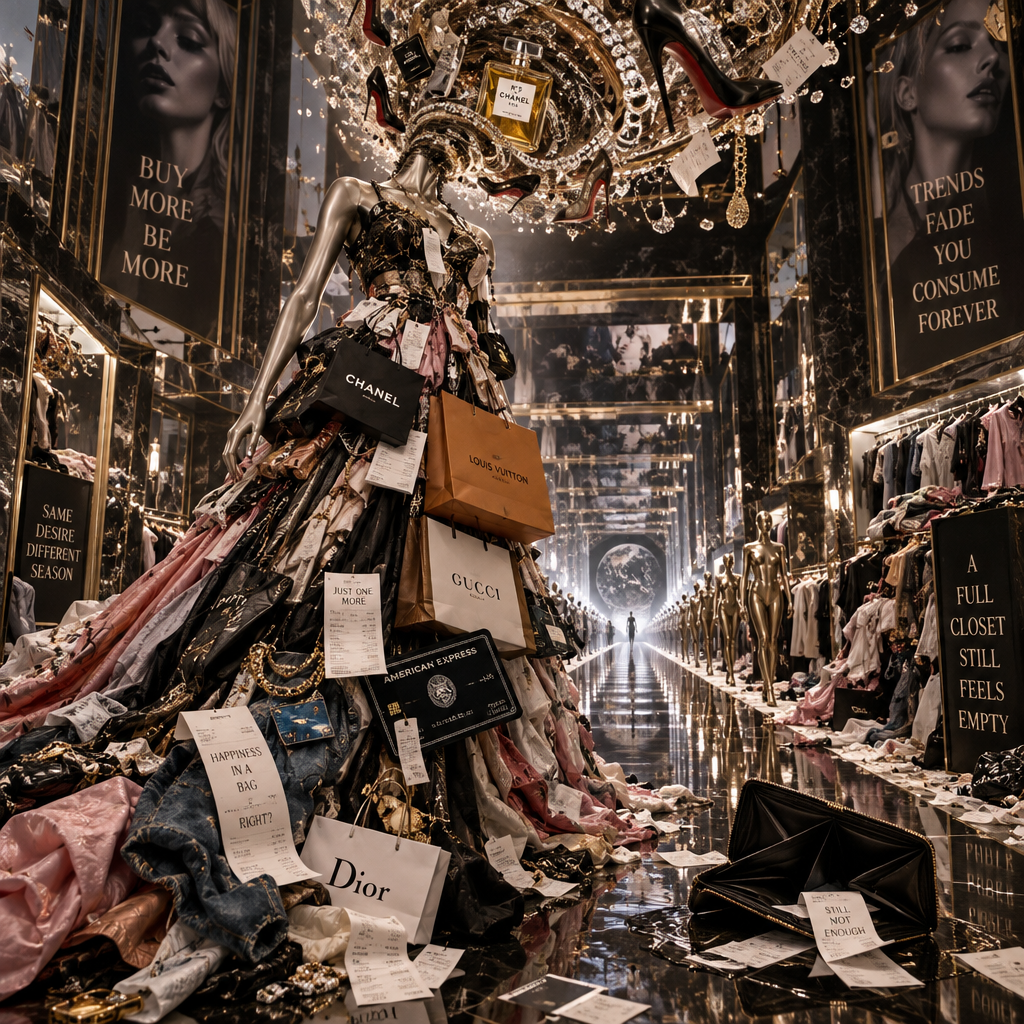
To “be your own person” has been what we have been told for decades; at least the whole of this writer’s life. A person is to “self-actualise”, that is, to become the ultimate version of themselves. Motivational speaker, Tony Robbins has told people that they can “awaken the giant within”.
But you can’t be your own person, unless you know what person you are, you can’t “self-actualise” unless you have an inkling of what the “self” is and you can’t awaken the giant unless you have an understanding of what sort of giant you might awaken and what it might do.
What sort of “own person” we are supposed to be is usually skirted around. Is that person an imago Dei or is it provided by the cultural production system, that is the whole apparatus of mainstream media which includes movie studios, streaming services, corporate and government broadcasters and advertising agencies? If it’s true that the media makes the person, the self, then you are not your own, but a creation by someone else.
The 2006 film, The Devil Wears Prada, does not hold back in pointing out that your choices are made for you. One of the main characters, Miranda Priestly, explains it like this:
You… go to your closet, and you select… I don’t know, that lumpy blue sweater, for instance, because you’re trying to tell the world that you take yourself too seriously to care about what you put on your back, but what you don’t know is that that sweater is not just blue, it’s not turquoise, it’s not lapis, it’s actually cerulean.
You’re also blithely unaware of the fact that, in 2002, Oscar de la Renta did a collection of cerulean gowns, and then I think it was Yves Saint Laurent, wasn’t it?… who showed cerulean military jackets. I think we need a jacket here.
And then cerulean quickly showed up in the collections of eight different designers. Then it filtered down through the department stores and then trickled on down into some tragic casual corner where you, no doubt, fished it out of some clearance bin.
However, that blue represents millions of dollars of countless jobs, and it’s sort of comical how you think that you’ve made a choice that exempts you from the fashion industry when, in fact, you’re wearing a sweater that was selected for you by the people in this room…
Even if you don’t follow the fashion industry, even if you attempt to rebel against it and even if you choose clothes that you think show you are that rebel, you are still wearing their products.
The film, The Devil Wears Prada, as a product of the cultural production system, is an advertisement for the fashion business; it affirms the importance of magazines and designers who determine the trends. The film is, thus, a paean for the status quo, but it nevertheless contains truths about the rottenness of that very system. Most media properties that act as propaganda can be similarly deconstructed and pulled apart.
For those of us who are steeped in the artificial culture produced by the cultural production system, it’s important to engage with it and its products so as to free ourselves. Although, in theory it may be better to eschew the cultural media properties, so as not to be distracted by them 1, in practice we must disentangle our minds from them.
Body image, relationships and many other things are constructed by the cultural production system. And people want to conform. As Miranda Priestly says: “Everyone wants this. Everyone wants to be us.”
The media creates the image of success and people seek that image. The fact that the protagonist, Andrea Sachs, then leaves Miranda and her world does not deny this point. It confirms it. Andrea applies for a job at a newspaper to cover labour relations, and the editor, Greg Hill, rings Miranda Priestly for a reference. So rather than walking away from Miranda’s world, Andrea is still embedded in it. The apparent dichotomy of the world of fashion journalism and the world of labour relations journalism is a false one. They are of the same cloth, of the same society and even, as Andrea’s trajectory shows, of the same people. Andrea, having proven her skills in fashion, is to apply them to labour relations journalism.
In this way the film sets up what is expected of people once they enter a high level career. The idol of success must prioritised above all, and everything, even relationships, must be sacrificed to it:
Andrea: My personal life is falling apart.
Nigel: That’s what happens when you start doing well at work. Let me know when your entire life goes up in smoke, then it’s time for a promotion.
The film thus normalises dysfunctional relationships as do many products of the cultural production system, such as the film, When Harry Met Sally or the TV shows Friends or Sex and the City.
The cultural production system also tells us what body type to prefer, whether its steroid-enhanced muscularity or the stick thin bodies of Twiggy and Kate Moss. A character, Emily, says to Andrea: “I’m on this new diet. Well, I don’t eat anything and when I feel like I’m about to faint I eat a cube of cheese. I’m just one stomach flu away from my goal weight.” Such attitudes, extant at least since the 1960s, unleashed a wave of mental illness in the form of anorexia.
Modern consumerism doesn’t really care for morality; it tends to curtail spending. The film plays to this, emphasising how the cultural production system destroys a sense of propriety; it warps the way you think and the values by which to live. It is clear that success means seeking the darkness.
As Andrea starts an affair with Christian Thompson, a writer, they have this interchange:
Christian: You, my friend, are crossing over to the dark side.
Andy: I resent that.
Christian: You shouldn’t: it’s sexy.
If evil is “sexy”, then perhaps people will not hold back on their evil to increase their sexiness. Another reference to evil is when Andrea is told: “You sold your soul to the devil when you put on your first pair of Jimmy Choos, I saw it.”
The implication is that to get ahead you have to be willing to eschew the good. Evil is a trifle that is sexualised and turned into a joke. It’s as if the cultural production system suggests meddling in the occult is harmless fun as in Bewitched, Charmed, Buffy, Sabrina and Wednesday whereas serious religion is for lunatics or to be the butt of jokes as in The Big Bang Theory. The supernatural is permitted as entertainment or disorder, never as a means to a properly ordered life.
If one internalises the values of the cultural production system, you can’t ever be “your own person”. It’s a fiction as Andrea’s lumpy cerulean sweater shows. It is as much a fiction as trying to ape a runway model, say, Kate Moss. Either way, it involves an appeal to vain pride that nudges one to make choices that one can’t tell aren’t one’s own. That slogan only makes sense if we can ask, “which person is my own”? Is it a person curated by trends, passions, corporations, movie studios, newspapers and brands, or is it a unique person created “ad imaginem Dei”?
We cannot be true to ourselves unless we are true to our natures. That nature is not in its essence a wreck full of pride and carnal desires.
If we are made in the image of God, we are made not to construct some consumerist ape of a person, but to become closer to that image, to align our wills and journey towards theosis.
-
Throw away thy books; no longer distract thyself – Marcus Aurelius The Meditations ↩︎